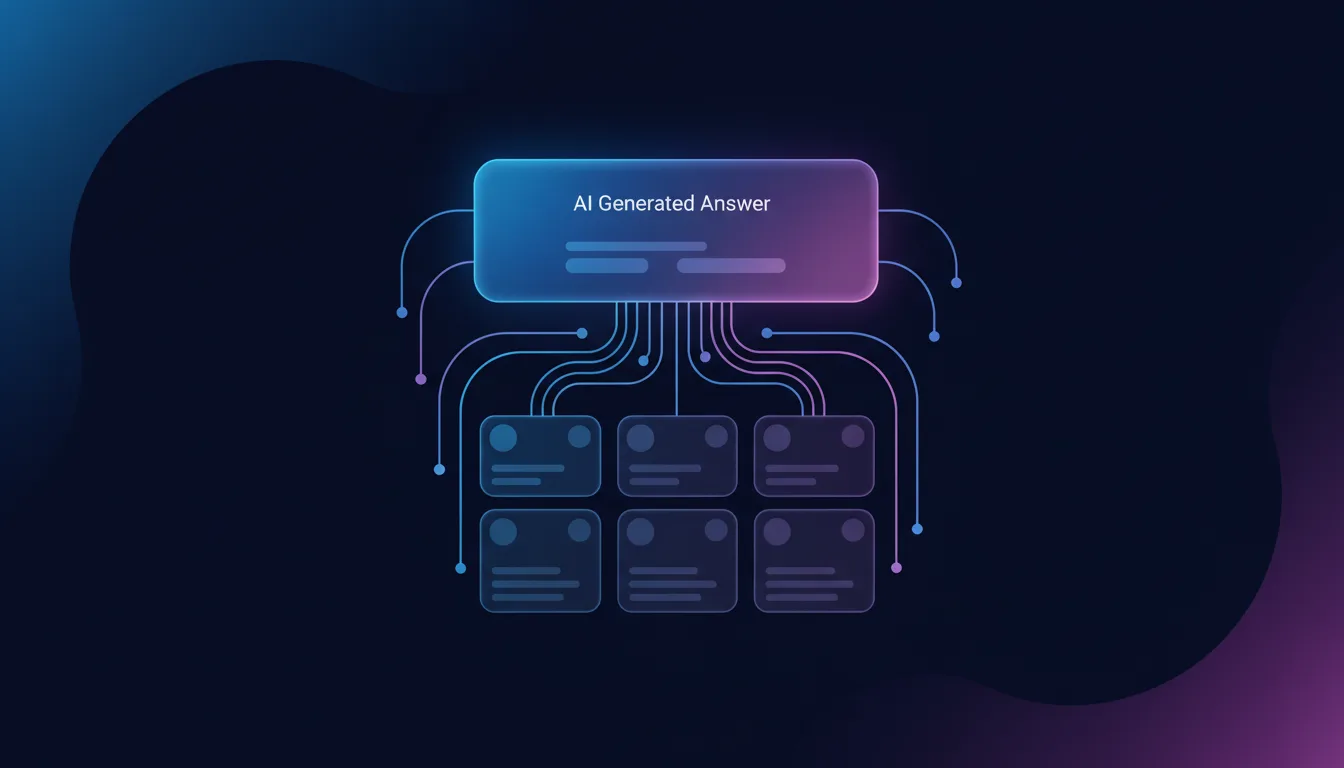
What Is AI Overview?
AI Overview is a feature in Google Search that generates a short, AI-written answer at the very top of the results page — above all organic rankings, ads and featured snippets. It debuted as Search Generative Experience (SGE) in 2023 and rolled out broadly under the name AI Overview in 2024, becoming a standard part of Google Search for users across major markets.
When a user types a question or informational query, Google's AI synthesises an answer from multiple web sources and presents it as a single, readable summary. Below that summary, Google lists the sources it drew from — small cards with the page title, favicon and a link. Those citations are the new prime real estate in search.
In practical terms: if your page is cited in an AI Overview, you appear before position one. If you are not cited, you may still rank in the organic list below — but for many users, the AI answer is enough and they never scroll further.
How AI Overview Decides What to Cite
Google does not publish a precise algorithm for AI Overview citations, but the signals that drive selection are well understood from research and observation in 2026.
Topical authority is the most consistent factor. Pages that cover a subject in depth, demonstrate expertise and are already trusted by Google for that topic are far more likely to be pulled into the summary. A page that ranks well organically has a head start, but ranking alone is not sufficient — the content also needs to be structured so the AI can extract a clean, direct answer.
Answer clarity matters enormously. AI Overview favours content that states its answer explicitly and early. A paragraph that buries its main point in qualifications is harder for the model to extract than a sentence that opens with the fact. Short definitions, numbered steps, comparison tables and direct Q&A formats all perform well in AI-selected answers.
Schema markup and structured data help Google understand what type of content is on the page — a how-to, a FAQ, a product, a local business. Pages with correct schema give the AI clearer signals about what the content is and how it should be used. This is part of why technical SEO fundamentals remain as important as ever, even as the interface shifts from blue links to generated summaries.
E-E-A-T signals — Experience, Expertise, Authoritativeness and Trustworthiness — continue to influence which sources Google is willing to surface in an AI-generated answer. Author credentials, clear sourcing, accurate facts and a site with a consistent publishing history all contribute.
Content freshness is a factor for time-sensitive queries. If your page was last updated two years ago and competitors have published more recent material, the AI is likely to prefer the newer source.
Why AI Overview Changes Your SEO Strategy
Before AI Overview, the goal of SEO was to rank in the top three positions and earn clicks. That model still applies — but it now runs in parallel with a different objective: getting cited as a source in the AI-generated answer.
The two goals are related but not identical. A page can rank in position four and still be cited in the AI Overview above position one. Conversely, a page can hold position one and not appear in the AI summary at all, because its content is not structured in a way the model can extract cleanly.
This is why content strategy has shifted. It is no longer enough to write long, comprehensive articles optimised around a keyword. Content now needs to be written with AI extraction in mind — clear headings, concise answers, defined entities and explicit statements that a language model can lift and attribute to your site.
For businesses operating in Thailand, this shift is particularly relevant because the competitive landscape in English-language search is still developing. There is a real opportunity to establish topical authority and get cited in AI Overviews before larger international competitors do. Our guide on 7 things you need to do to be found by AI search engines covers the practical steps in detail.
It is also worth noting that AI Overview is not the only AI-powered answer surface you need to consider. ChatGPT, Perplexity and Gemini all generate answers from web content using similar logic. A strategy that targets AI Overview citation tends to improve your visibility across all of these platforms simultaneously — which is the core idea behind Generative Engine Optimization.
How to Optimise for AI Overview in 2026
Here is a practical framework for improving your chances of being cited.
1. Identify the queries where AI Overview already appears. Not every search triggers an AI Overview. Informational and question-based queries are far more likely to produce one than transactional queries. Search your target terms and note which ones show an AI Overview — those are the pages to prioritise.
2. Rewrite your opening paragraphs to lead with the answer. The AI tends to pull from the first 100–200 words of a page. If your answer is buried in paragraph five, restructure the page so the direct answer comes first, with supporting detail following.
3. Add FAQ sections with explicit questions and answers. A clearly marked FAQ at the bottom of a service or article page gives the AI a well-formatted source to draw from. Each question should match a real search query; each answer should be self-contained.
4. Implement FAQ and HowTo schema where appropriate. Structured data does not guarantee citation, but it removes ambiguity about what type of content the page contains. A thorough SEO audit will identify where schema is missing or incorrectly implemented on your site.
5. Build topical depth, not just individual pages. A single well-optimised page is weaker than a cluster of related pages that collectively cover a topic from multiple angles. Internal linking between those pages reinforces topical authority and helps Google understand the breadth of your coverage.
6. Earn external references and citations. Pages that are linked to or cited by other authoritative sites are more trusted. This is where link building and digital PR intersect with AI visibility — the more your content is referenced across the web, the more credible it appears as a source for AI-generated answers.
7. Keep content current. Review your most important pages at least twice a year. Update statistics, refresh examples and make sure the information reflects current reality. Stale content loses citation priority over time.
If you want to see how this kind of optimisation translates into measurable results, the work we did for Viztek Display is a useful reference — a business that went from zero digital presence to consistent monthly leads through structured content and technical SEO.
AI Overview is not a temporary experiment. It is the direction Google is moving in, and the businesses that adapt their content strategy now will hold a significant advantage as the feature continues to expand. If you want to understand where your site currently stands, get in touch with our team for a conversation about what it would take to get cited.